Principle of marriage freedom consent
Just DesertsThe free-consent principle in marriage is a religious, moral, and practical rule that no woman can be compelled to marry merely because a man is available, an estate requires protection, or her family demands compliance. Its decisive force in the narrative lies in Elizabeth Bennet’s insistence that a marriage without her willing agreement would be a form of purchase rather than a partnership. The principle therefore connects personal dignity with Canon Law, family power, property succession, and the difference between an apparent choice and a choice made under intolerable pressure.
Definition and Religious Foundation
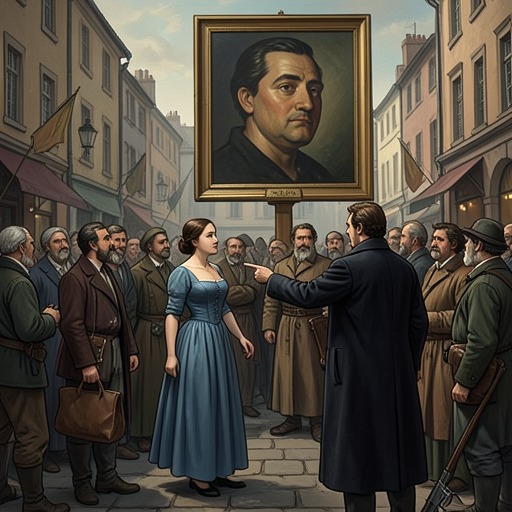
Elizabeth Bennet presents free consent as a direct answer to the marriage expectations imposed upon her. When William Collins proposes, she refuses because she neither respects him nor can imagine loving him; his status as heir to Longbourn does not create an obligation to accept him. More seriously, William Collins refuses to believe that her refusal is sincere, relying instead on the convention that a woman initially says no merely to heighten a suitor’s suspense. His conduct turns a formal proposal into an attempt to override her speech.
Elizabeth explicitly connects this issue to Canon Law, arguing that a bride cannot be forced to marry. Her appeal is supported by her knowledge of biblical texts, including the rarely quoted injunction from Ephesians that parents must not provoke their children to anger. In the same argument, she contrasts the familiar command that children obey their parents with the less frequently cited duty imposed on parents. The contrast gives religious language an emancipatory use: scripture is not treated as a one-sided instrument of filial obedience, but as a body of principles that also limits parental authority.
Her religious reasoning is not simplistic. At Oakham Mount, Elizabeth wrestles with contradictory biblical teachings about vengeance, recalling both the declaration that vengeance belongs to the Lord and the passage stating that it is just to repay those who afflict others. She recognizes the danger of selecting only the verse that suits a desired conclusion. That intellectual caution also informs her understanding of marriage: authority cannot be legitimized merely by quoting the most convenient rule while ignoring the duties and restraints that accompany it.
Elizabeth Bennet’s Rejection of William Collins
The immediate conflict arises because William Collins is the heir to Longbourn and Mrs. Bennet treats his proposal as the family’s essential safeguard. Elizabeth, however, separates the estate’s legal predicament from her own consent. She explains that she refused William Collins not because she lacked affection for her family, but because accepting him would mean allowing herself to be sold for Longbourn. Her language exposes the economic structure beneath the supposedly respectable marriage market: the daughter’s body and future are made to carry the burden of an inheritance system created by men.
William Collins’s refusal to listen makes the proposal coercive even before any physical force is used. He assumes that Elizabeth’s words have no authority over the decision and substitutes his own script for her answer. His belief that women conventionally resist before yielding transforms female speech into a performance that men may discount whenever it contradicts their expectations. Elizabeth’s rejection therefore asserts not merely a preference against one unsuitable suitor, but the legal and moral validity of a woman’s spoken refusal.
Thomas Bennet eventually supports Elizabeth’s decision, preventing Mrs. Bennet from forcing the match through his authority as her father. Yet Elizabeth’s account makes clear that the family victory is incomplete. Mrs. Bennet’s immediate retaliation makes life intolerable, and Elizabeth doubts whether her mother has ever loved her, while knowing that Mrs. Bennet loves Longbourn more than she loves her daughter. The principle of consent thus exposes a painful hierarchy of loyalties: the estate is treated as worthy of sacrifice, whereas the daughter expected to preserve it is denied emotional consideration.
The aftermath confirms the social pressure surrounding such refusals. William Collins proposes to Charlotte Lucas only two days later, and Charlotte accepts. Elizabeth does not interpret that acceptance as proof that her own refusal was foolish; instead, the contrast shows that marriage decisions depend upon circumstances, priorities, and the freedom available to each woman. Elizabeth seeks the deepest love, while Charlotte’s acceptance reveals how a woman’s need for security can lead her to enter a marriage that Elizabeth could not accept without violating her own understanding of consent.
Consent Under Property and Family Pressure
The principle becomes inseparable from the Longbourn entail. The family later establishes that there are no male heirs in any line descending from Martin Bennet, whose service to Charles the Second had brought him the deed to Longbourn and its attendant lands. After the final heir dies without male issue, the entail is declared broken. This legal development removes the immediate justification for treating Elizabeth’s marriage as the family’s only possible defense against dispossession.
That revelation retrospectively sharpens Elizabeth’s earlier resistance. Mrs. Bennet’s pressure had presented marriage to William Collins as necessary because of the estate’s succession, but the family’s later legal investigation demonstrates that inheritance rules, not Elizabeth’s moral duty, created the danger. The rule of free consent stands against the tendency to convert a woman into an instrument of estate management. Once the male succession fails, the alleged necessity of sacrificing Elizabeth becomes visibly contingent rather than inevitable.
The same tension appears in Sir David Pentland’s efforts to secure Elizabeth’s future. His concern is not that she should marry for his convenience, but that her arrival at Grenadine Reef, her vulnerability within the Bennet household, and the urgency of her reaching legal adulthood have left him too little time to create a long-term solution by ordinary means. His terminal cancer makes his plans increasingly urgent, and he turns to a proposed marriage settlement and a marriage of convenience as a means of protecting her.
Sir David nevertheless acknowledges the moral cost of his proposal. He explains that the arrangement depends upon Elizabeth and Fitzwilliam Darcy placing their personal happiness on hold for a year. The request is not a simple financial bargain: it places emotional pressure upon both of them and risks using Elizabeth’s precarious position to obtain their agreement. Fitzwilliam Darcy is torn because he wants to protect Elizabeth while also resenting Sir David’s interference in their lives. The episode shows that consent can be compromised without an openly brutal command; urgency, dependence, illness, and property can exert a coercive force even when the proposer is benevolent.
Marriage, Ceremony, and the Limits of Compulsion
Elizabeth ultimately marries Sir David Pentland six days after his proposal, by common licence. The ceremony is shaped by his rapidly failing health. He must be carried into the church in a chair because he can no longer walk; his brother serves as groomsman, Edward Gardiner escorts Elizabeth down the aisle, and Lily is her maid of honour. The congregation includes servants and tenants from the estate, making the small church unexpectedly full and turning the wedding into a public declaration of approval for Elizabeth as the new mistress of Grenadine Reef.
The ceremony also reflects the interaction between religious institutions and personal choice. Lady Radha Pentland had converted to the Church of Scotland when she married Sir David, while Sir David later converted so that he could worship at the local Church of England church. The vicar, a friend of Sir David, performs the service under the rites of the Church of England. The short, functional ceremony does not erase the unusual circumstances surrounding the match, but it gives the marriage public and ecclesiastical recognition rather than leaving it as a purely private property arrangement.
Sir David’s marriage to Elizabeth is not presented as a conventional romantic triumph. His proposal is designed to protect her and preserve the estate’s future, while Elizabeth’s own love is directed toward Fitzwilliam Darcy. Yet the marriage is not reduced to a fraudulent transaction. Elizabeth chooses to accept the burden, and Sir David’s conduct is marked by concern for her welfare rather than entitlement to her affection. The narrative consequently distinguishes between a marriage entered under difficult circumstances with a woman’s informed agreement and a marriage imposed through the refusal to hear her no.
Sir David never leaves his bedroom alive after the wedding. Elizabeth sits with him through Friday and Saturday, reading aloud while uncertain whether he remains sufficiently lucid to know she is present. She becomes a widow the following morning. The brevity of the marriage underlines its protective and legal purpose, but Elizabeth’s care gives it an ethical dimension that cannot be measured by duration alone. Consent here does not guarantee happiness or permanence; it establishes that even a sacrificial marriage must be chosen by the person whose life it reorganizes.
Coercive Substitutes and Narrative Significance
The novel contrasts marriage consent with other forms of forced agreement. When Lydia Bennet attempts to elope with Lieutenant Denny, the authorities use both inducement and threat to secure a marriage. The financial offer is the carrot, but the decisive pressure is the stick: if Lieutenant Denny does not carry out the stated ruse of marriage, he may be court-martialled for desertion and, if convicted, shot. His threatened execution is justified as a military example intended to discipline the British Militia, and he accepts the arrangement immediately while facing uncertainty about whether the charge would actually be proved.
Lieutenant Denny’s case demonstrates that a marriage can be formally agreed to while still being shaped by coercion. The threat is directed at him rather than at Lydia Bennet, but the result is a forced marital settlement designed to contain social and military disorder. The episode therefore prevents the principle from being understood narrowly as a rule protecting only women from family matchmaking. It also asks whether agreement produced by fear can count as free consent at all.
The novel’s repeated attention to marriage settlements, military punishment, church authority, and inheritance reveals a plural legal world in which different systems claim the power to define legitimate choice. Canon Law supplies a principle against forced marriage; family custom treats daughters as instruments of succession; property documents determine who may inherit Longbourn; ecclesiastical ceremony confers public legitimacy; and military law threatens death to compel Lieutenant Denny’s compliance. Elizabeth’s resistance is powerful because she moves among these systems without allowing any of them to erase her own will.
Free consent therefore functions as both a rule and a test of social morality. It condemns William Collins’s assumption that Elizabeth’s refusal is merely theatrical, exposes Mrs. Bennet’s willingness to subordinate her daughter to Longbourn, complicates Sir David’s benevolent marriage proposal, and casts doubt on agreements produced by military terror. Against the idea that a woman may be exchanged for property, reputation, or family stability, the narrative insists that marriage begins with a voice that must be heard and a refusal that must remain capable of ending the negotiation.